
Awaab's Law, Damp and Mould in UK Rented Homes: Timeframes, Evidence and Practical Steps
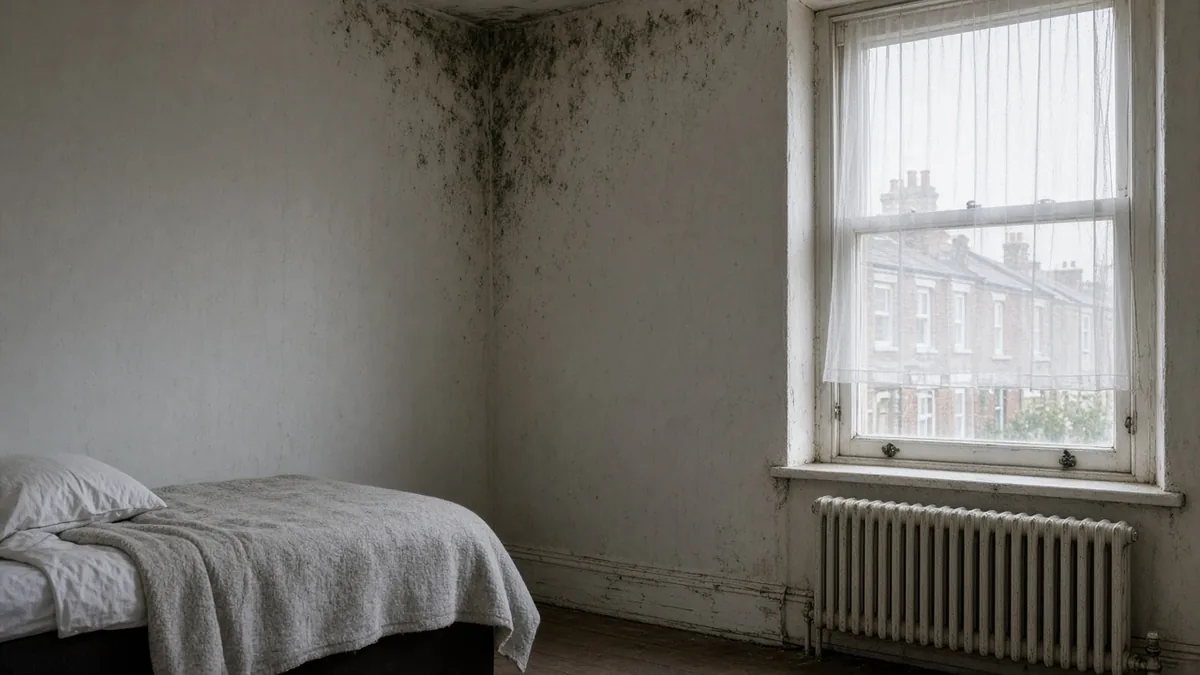
Under GOV.UK's Awaab's Law regulations in England, social landlords must investigate and make emergency damp or mould hazards safe within 24 hours, and investigate significant hazards within 10 working days (with safety work starting within 5 working days of findings). Private renters remain covered by statutory repair and fitness laws; logging room temperature and relative humidity with a £8–£17 digital hygrometer helps prove whether ventilation or building defects are driving the problem.
Damp and black mould remain disproportionately concentrated in Britain's rented housing stock. According to the GOV.UK English Housing Survey 2024 to 2025 headline findings, 5% of all dwellings in England (1.4 million homes) had a surveyor-assessed damp problem in 2024—rising to 10% in the private rented sector and 7% in social rented homes, compared with 4% in owner-occupied housing. Crucially, 60% of homes recorded as having inadequate ventilation also suffered from damp.
If you live in a damp rented flat or house, knowing the statutory rules—alongside how to document objective humidity data—helps you get permanent repairs rather than being brushed off with "open a window" boilerplate.
Health Risks: Why Damp and Mould Are Treated as Housing Hazards
Dampness and visible mould are not merely cosmetic decoration issues. As NHS guidance from Manchester University NHS Foundation Trust and Dartford and Gravesham NHS Trust explains, mould releases airborne spores and irritants that can trigger or worsen asthma, wheezing, coughing, chest infections, allergic rhinitis, eye irritation, and eczema.
NHS primary care guidance on mould-related illnesses highlights that babies, young children, pregnant women, older adults, and anyone with existing respiratory conditions or weakened immunity face higher risk. In England, 2019 epidemiological estimates linked indoor damp and mould to approximately 5,000 new or aggravated asthma cases and 8,500 lower respiratory infections.
Awaab's Law Timeframes in England (Phase 1 & Phase 2)
Introduced following the death of two-year-old Awaab Ishak, the Hazards in Social Housing (Prescribed Requirements) (England) Regulations 2025—known as Awaab's Law—took effect for social landlords in England on 27 October 2025, with Phase 2 guidance applying from 30 November 2026 (incorporating wider HHSRS hazards).
Under GOV.UK's tenant and landlord guidance, social landlords must follow strict deadlines once notified:
| Hazard Classification | Legal Test & Examples | Statutory Timeframe |
|---|---|---|
| Emergency hazard | Poses an imminent and significant risk of harm (for example severe mould affecting a child's asthma or an acute leak/heating loss in winter) | Investigate and carry out safety action within 24 hours |
| Significant hazard (damp & mould) | A hazard that a reasonable landlord with relevant knowledge would make safe urgently (under Phase 2 triaging: within 15 working days) | Investigate within 10 working days; provide written summary within 3 working days; start safety/preventive works within 5 working days |
Two critical details in GOV.UK's Phase 2 hazard triaging guidance protect tenants:
- Vulnerability does not require medical notes: Landlords must consider residents' ages and health conditions from what you tell them—you do not have to produce a GP letter before an issue is treated seriously.
- Dehumidifiers are temporary, not a cure: GOV.UK explicitly gives "cleaning mould and providing a dehumidifier while scheduling wider works to prevent mould coming back" as an example of temporary interim safety action. A landlord cannot hand over a portable dehumidifier and consider structural disrepair or broken ventilation "fixed".
What About Private Renters and Other UK Nations?
- Private renters in England: While Awaab's Law regulations apply directly to social housing (with wider private-sector extension planned under rental reform), private tenants can enforce repairs under the Homes (Fitness for Human Habitation) Act 2018, Section 11 of the Landlord and Tenant Act 1985 (structure, exterior, and heating/water installations), or request a local council Environmental Health inspection under the Housing Health and Safety Rating System (HHSRS).
- Scotland, Wales, and Northern Ireland: Housing law is devolved—Scotland applies the Repairing Standard (via the First-tier Tribunal), Wales applies Fitness for Human Habitation under the Renting Homes (Wales) Act 2016, and Northern Ireland tenants can escalate severe disrepair via local council Environmental Health officers.
How to Build Objective Evidence With a Digital Hygrometer
Landlords and letting agents frequently blame condensation on tenant "lifestyle" (cooking, showering, or drying clothes indoors). Rather than arguing verbally, a £8–£17 digital thermo-hygrometer gives you timestamped evidence showing whether the building itself is failing to stay warm and dry.
- Log both temperature and relative humidity (RH): Relative humidity rises automatically when indoor temperatures fall. Showing that a bedroom sits at 14°C and 72% RH even with trickle vents open demonstrates poor insulation or inadequate heating rather than excessive moisture generation.
- Place the sensor away from radiators and windows: Put it on an internal shelf or chest of drawers at waist height in the worst-affected room, and avoid breathing directly onto it or placing it right next to a kettle.
- Choose data logging if disputes escalate:
- A standalone display such as the ThermoPro TP50 (£7.99 at the time of writing) lets you photograph daily min/max readings next to a clock or calendar.
- A Bluetooth logger like the Govee H5075 (£9.48) or Wi-Fi monitor like the Govee H5179 (£16.99) records continuous multi-week graphs you can export when emailing your landlord, council Environmental Health team, or tenancy deposit scheme.
- Test extractor fans and report defects in writing: Hold a single sheet of toilet tissue against a running bathroom or kitchen extractor fan. If it drops straight off rather than sticking lightly to the grille, the fan is failing or the ducting is blocked. Photograph faulty seals, perished window gaskets, missing trickle vents, and overflowing gutters, and send everything in a dated email.
Practical Day-to-Day Steps While Awaiting Repairs
While waiting for your landlord to repair an extractor fan, leaking gutter, or cold thermal bridge, Energy Saving Trust's condensation advice recommends safe daily habits that protect both your health and your tenancy deposit:
- Keep trickle vents open and purge-ventilate briefly: Open windows on opposite sides of the flat for at least five minutes a couple of times a day, and leave bathroom/kitchen extractors running for at least 15 minutes after showering or cooking.
- Avoid blocking wall circulation: Pull wardrobes and beds 5 cm away from cold external brick walls so stagnant air does not reach dew point behind furniture.
- Use a portable dehumidifier you can take with you: If indoor laundry or a cold rented bedroom keeps pushing RH above 60%, a compact portable compressor unit (such as the 101 W MeacoDry Arete One 6L at
2.66p/hror 200 W Pro Breeze OmniDry 12L at5.26p/hrat the Ofgem Q4 2026 cap of26.32p/kWh) keeps moisture down immediately—and because you own it, you take it with you when your tenancy ends. - Clean surface spots safely (do not dry-brush): Wipe small condensation spots with a damp cloth and mild detergent or HSE-approved fungicidal wash while wearing gloves and an FFP3 mask, keeping the window open so spores are not blown around the bedroom.
Never withhold rent over damp without formal legal advice, as arrears can undermine your statutory protections. Keep every email, photo, and hygrometer log in one folder so you can escalate cleanly to Environmental Health or the Housing Ombudsman if statutory deadlines pass.
Recommended In-Stock Models & Running Costs
Only models currently in stock on Amazon UK are shown below. Adjust the electricity rate to match your tariff.
| Model | Category | Power | Cost / hr | 8h Cycle | Amazon UK Price | Action |
|---|---|---|---|---|---|---|
| Hygrometers | — | — | — | £7.99 90-DAY LOW Price accurate as of 28/11/2026 04:49 GMT | Check price on Amazon | |
| Hygrometers | — | — | — | £9.48 90-DAY LOW Price accurate as of 28/11/2026 04:49 GMT | Check price on Amazon | |
| Hygrometers | — | — | — | £16.99 90-DAY LOW Price accurate as of 28/11/2026 04:49 GMT | Check price on Amazon | |
| Compressors | 101 W | 2.66p/hr | £0.21 | £129.99 90-DAY LOW Price accurate as of 28/11/2026 04:49 GMT | Check price on Amazon | |

Pro Breeze OmniDry 12L Quiet Dehumidifier with Max Extraction
12L/day
·
36 dB
|
Compressors | 200 W | 5.26p/hr | £0.42 | £118.99 90-DAY LOW Price accurate as of 28/11/2026 04:49 GMT | Check price on Amazon |


Product prices and availability are accurate as of the date/time indicated and are subject to change. Any price and availability information displayed on Amazon.co.uk at the time of purchase will apply to the purchase of this product.
Frequently Asked Questions
What are the exact Awaab's Law repair timeframes for damp and mould in social housing?
Under GOV.UK guidance for the Hazards in Social Housing (Prescribed Requirements) (England) Regulations 2025, emergency hazards require investigation and safety action within 24 hours. Significant damp and mould hazards require investigation within 10 working days, a written summary within 3 working days of investigation, and safety or preventive works within 5 working days (with Phase 2 guidance applying from 30 November 2026).
Does Awaab's Law apply to private landlords as well as council and housing association homes?
The 2025–2026 Awaab's Law Regulations apply specifically to social landlords in England, though wider private-rented reforms aim to extend similar protections. Private tenants in England already have rights under the Homes (Fitness for Human Habitation) Act 2018, Section 11 of the Landlord and Tenant Act 1985, and local council Environmental Health HHSRS inspections.
Does using a dehumidifier let my landlord off the hook for fixing structural damp?
No. GOV.UK's Awaab's Law Phase 2 triaging guidance explicitly notes that cleaning mould and providing a dehumidifier are temporary safety measures—landlords must still carry out wider works to stop the hazard recurring.
What evidence should a UK tenant collect before reporting damp or mould?
Take dated photos of affected walls, window seals, and ceilings, record whether bathroom and kitchen extractor fans actually pull air (for example using a tissue-paper suction check), note any leaks or broken trickle vents, and log room temperature and relative humidity twice daily with a standalone hygrometer.
More UK Damp & Running-Cost Guides
Why Condensation Forms on the Inside of UK Windows (Dew Point Explained)
Condensation forms on the inside of a window when the glass is colder than the dew point of the room air, so water vapour turns back into droplets on it. At 20°C and 60% relative humidity the dew point is roughly 12°C, so any pane or frame colder than about 12°C will mist up. Bringing the dew point down (less moisture, more ventilation, a dehumidifier) or warming the glass is the only way to stop it.
How to Clean Black Mould Safely Without Spreading Spores Around Your Home
Wear gloves, goggles and a mask over your nose and mouth, open the window but close the door to the rest of the house, then wipe the mould while it is wet using a mould and mildew product (GOV.UK advises these in preference to bleach) and a disposable cloth. Never brush, dry-wipe or vacuum mould. Bag the cloth and mask afterwards, and leave patches larger than about 1 m², or mould caused by leaks, to a professional or your landlord.
New-Build Homes in the UK: Drying Out Construction Moisture in Year One
NHBC says up to 8,000 litres of water can go into building a new home, and that a new home should reach a moisture-balanced state within 18 months to 2 years. Because modern homes are insulated and draught-proofed, that moisture and everyday steam escape slowly, so keep trickle vents open, run extractors, heat evenly rather than hot, avoid drying clothes on radiators, and use a dehumidifier if condensation persists. Ongoing damp or mould is not normal and should be reported to your builder.